


Our COO, Josh Burroughs, recently joined as a panelist at the City of San Jose Council Study Session focused on the Cost of Residential Development in San Jose, exploring strategies to support the City’s focus on building more housing. With decades of experience in San Jose real estate and multiple high-rise developments under his belt, Josh offered both context and actionable insights into the city’s housing market.
San Jose’s Housing Production in Context
Josh highlighted that while San Jose produces a significant volume of housing compared to neighboring cities, per capita metrics show there is room for growth. Neighboring cities are producing 5–10 times more housing per resident despite facing similar construction costs, land prices, and impact fees.
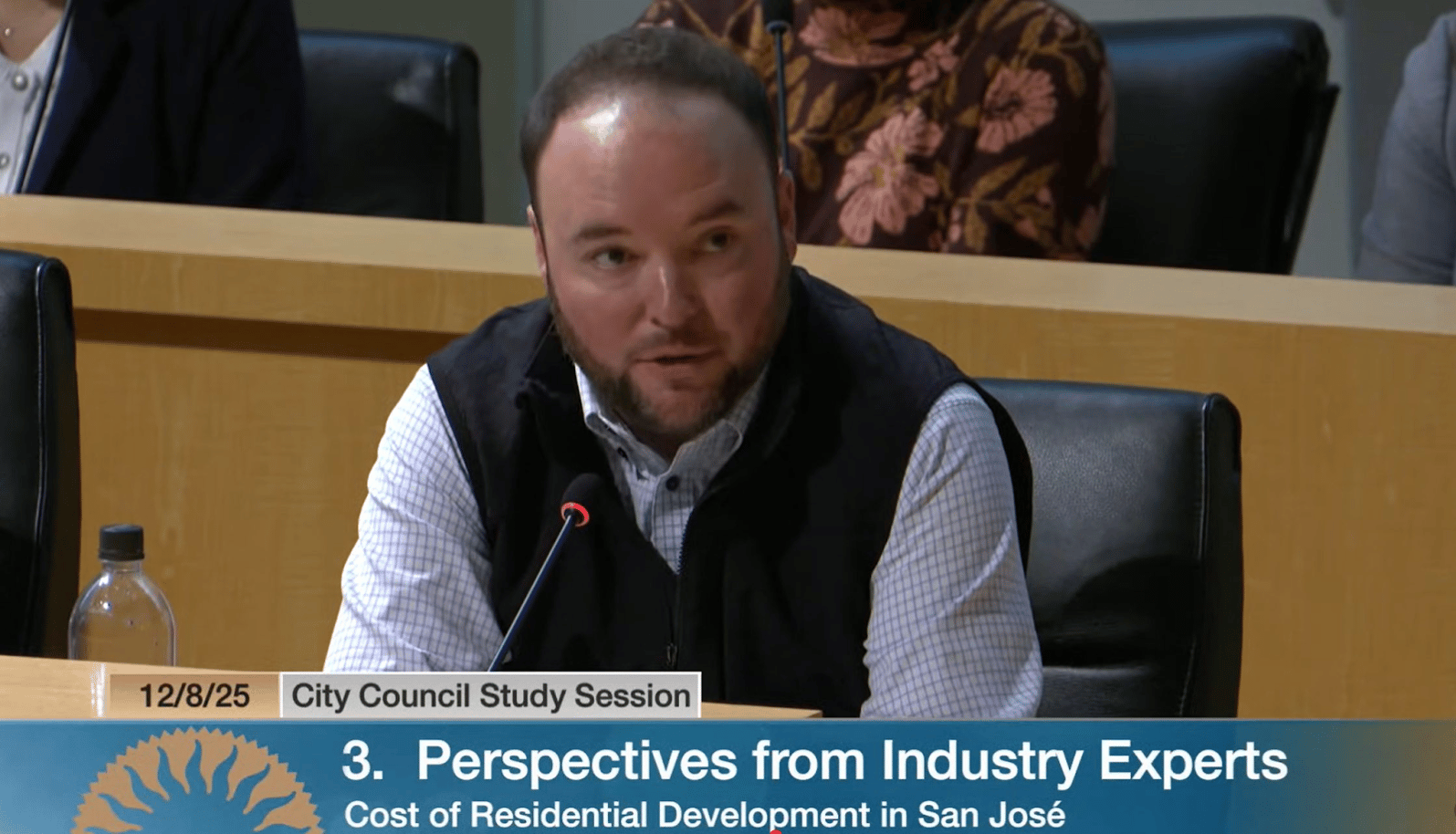 DEC 8, 2025 | City Council Study Session: Cost of Residential Development in San Jose | Josh speaking from 1:07:22 - 1:13:45
Market-Rate Development and City Growth
Currently, only a handful of market-rate developers are breaking ground in San Jose, which is insufficient for a city of its size and growth potential. Josh believes there should be a dozen major projects per district, especially in a city where 90% of the land is single-family homes.
Construction costs have stabilized post-COVID, and Urban Catalyst is pushing the envelope with eight-story buildings that maximize density. Unlike many developers who use multiple floors for parking and limit residential units, Urban Catalyst uses automated parking on the first floor only, freeing up the remaining seven floors entirely for residential units. This approach allows the city to reach up to 350 units per acre, compared to the more typical 250 units per acre or less achieved by conventional methods with three floors of parking or 4-6 story buildings.
Opportunities for Policy Adjustments
Josh highlighted several policy areas that could support development and investor confidence:
- Fee Structures: Certain fees are charged per unit rather than per square footage, which may not align with actual impact.
- Fee Deferrals: Delaying fees until certificate of occupancy would match costs with actual impact.
- Property Taxes: Representing nearly half of operating expenses, property taxes are a key factor in return-on-cost calculations that influence investment decisions.
- Lessons from Other States: Programs in Washington, for example, have spurred hundreds of projects, delivering tens of thousands of new housing units.
Building for the Future
Josh also emphasized the intersection of housing and workforce. As AI and tech companies expand locally, market-rate development is critical to house tech workers and keep older class B and C apartments naturally affordable for other residents.
San Jose is at a pivotal moment. The choices the City Council makes now will have lasting effects on housing availability, affordability, and investor confidence. Supporting diverse housing types, innovative building strategies, and smart policy incentives are key to a thriving, resilient city.
👉 Contact us to learn more.
Important Disclosures
The contents of this communication: (i) do not constitute an offer of securities or a solicitation of an offer to buy securities, (ii) offers can be made only by the confidential Private Placement Memorandum (the “PPM”) which is available upon request, (iii) do not and cannot replace the PPM and is qualified in its entirety by the PPM, and (iv) may not be relied upon in making an investment decision related to any investment offering by an issuer, or any affiliate, or partner thereof ("Issuer").
All potential investors must read the PPM and no person may invest without acknowledging receipt and complete review of the PPM.
With respect to any performance levels outlined herein, these do not constitute a promise of performance, nor is there any assurance that the investment objectives of any program will be attained. All investments carry the risk of loss of some or all of the principal invested. Assumptions are more fully outlined in the Offering Documents/ PPM for the respective offering. Consult the PPM for investment conditions, risk factors, minimum requirements, fees and expenses and other pertinent information with respect to any investment.
These investment opportunities have not been registered under the Securities Act of 1933 and are being offered pursuant to an exemption therefrom and from applicable state securities laws. All offerings are intended only for accredited investors unless otherwise specified.
Past performance are no guarantee of future results. All information is subject to change. You should always consult a tax professional prior to investing. Investment offerings and investment decisions may only be made on the basis of a confidential private placement memorandum issued by Issuer, or one of its partner/issuers. Issuer does not warrant the accuracy or completeness of the information contained herein. Thank you for your cooperation.
Real Estate Risk Disclosure:
- There is no guarantee that any strategy will be successful or achieve investment objectives including, among other things, profits, distributions, tax benefits, exit strategy, etc.;
- Potential for property value loss – All real estate investments have the potential to lose value during the life of the investments;
- Change of tax status – The income stream and depreciation schedule for any investment property may affect the property owner’s income bracket and/or tax status. An unfavorable tax ruling may cancel deferral of capital gains and result in immediate tax liabilities;
- Potential for foreclosure – All financed real estate investments have potential for foreclosure;
- Illiquidity – These assets are commonly offered through private placement offerings and are illiquid securities. There is no secondary market for these investments.
- Reduction or Elimination of Monthly Cash Flow Distributions – Like any investment in real estate, if a property unexpectedly loses tenants or sustains substantial damage, there is potential for suspension of cash flow distributions;
- Impact of fees/expenses – Costs associated with the transaction may impact investors’ returns and may outweigh the tax benefits
- Stated tax benefits – Any stated tax benefits are not guaranteed and are subject to changes in the tax code. Speak to your tax professional prior to investing.
Opportunity Zone Disclosures
- Investing in opportunity zones is speculative. Opportunity zones are newly formed entities with no operating history. There is no assurance of investment return, property appreciation, or profits. The ability to resell the fund’s underlying investment properties or businesses is not guaranteed. Investing in opportunity zone funds may involve a higher level of risk than investing in other established real estate offerings.
- Long-term investment. Opportunity zone funds have illiquid underlying investments that may not be easy to sell and the return of capital and realization of gains, if any, from an investment will generally occur only upon the partial or complete disposition or refinancing of such investments.
- Limited secondary market for redemption. Although secondary markets may provide a liquidity option in limited circumstances, the amount you will receive typically is discounted to current valuations.
- Difficult valuation assessment. The portfolio holdings in opportunity zone funds may be difficult to value because financial markets or exchanges do not usually quote or trade the holdings. As such, market prices for most of a fund’s holdings will not be readily available.
- Capital call default consequences. Meeting capital calls to provide managers with the pledged capital is a contractual obligation of each investor. Failure to meet this requirement in a timely manner could elicit significant adverse consequences, including, without limitation, the forfeiture of your interest in the fund.
- Opportunity zone funds may use leverage in connection with certain investments or participate in investments with highly leveraged capital structures. Leverage involves a high degree of financial risk and may increase the exposure of such investments to factors such as rising interest rates, downturns in the economy or deterioration in the condition of the assets underlying such investments.
- Unregistered investment. As with other unregistered investments, the regulatory protections of the Investment Company Act of 1940 are not available with unregistered securities.
- It is possible, due to tax, regulatory, or investment decisions, that a fund, or its investors, are unable realize any tax benefits. You should evaluate the merits of the underlying investment and not solely invest in an opportunity zone fund for any potential tax advantage.
The above material cannot be altered, revised, and/or modified without the express written consent of Urban Catalyst.