

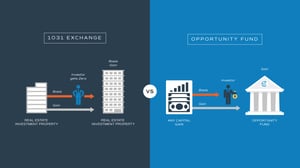
If you are holding a substantial capital gain — from selling a company, a block of appreciated stock, cryptocurrency, or an investment property — two widely used tax-deferral provisions in the U.S. tax code are the Opportunity Zone program and the 1031 like-kind exchange. Each may allow you to postpone capital gains tax you would otherwise owe today, but they work very differently, suit different goals, carry their own risks, and changed meaningfully in 2025. This guide explains the Opportunity Zone vs. 1031 comparison in plain language to support a more informed conversation with your own tax and financial advisors. It is not a recommendation of either strategy.
|
The short answer A 1031 exchange generally lets real estate investors defer capital gains by rolling proceeds into new like-kind real property. An Opportunity Zone investment can accept gains from almost any asset, requires you to reinvest only the gain (not your principal), and — after a 10-year hold and if all program requirements are met — may allow the appreciation on your new investment to be excluded from federal capital gains tax. The trade-off: with an Opportunity Zone, you generally still owe tax on the original deferred gain at a future date, whereas a 1031 may defer that gain until death. The right choice depends on the asset you sold, your time horizon, your risk tolerance, and whether you want active real estate ownership or passive fund exposure. Both strategies involve meaningful risks, including possible loss of principal and illiquidity, and their tax benefits are not guaranteed. Discuss your specific situation with qualified advisors before acting. |
What Is a 1031 Exchange?
A 1031 exchange — named for Section 1031 of the Internal Revenue Code — allows an investor to sell real property held for business or investment use and defer the capital gains tax by reinvesting the proceeds into like-kind replacement real estate. “Like-kind” is interpreted broadly: an apartment building can be exchanged for raw land, a retail center, or a rental home, as long as both are U.S. real property held for investment or business use. Since the 2017 Tax Cuts and Jobs Act, only real property qualifies — personal property and equipment no longer do.
To complete a valid exchange, investors must follow strict rules:
-
Use a qualified intermediary. A neutral third party must hold the sale proceeds. If you take possession of the cash, you trigger “constructive receipt” and the exchange fails.
- Meet the 45-day deadline. You must identify potential replacement properties in writing within 45 days of the sale.
- Meet the 180-day deadline. You must close on the replacement property within 180 days of the sale (or by your tax-filing deadline, if earlier). There are no extensions.
- Reinvest fully and replace debt. To defer 100% of the tax, you generally must reinvest all net proceeds and replace any debt that was paid off. Cash or debt relief you keep is taxable “boot.”
A 1031 exchange defers both the capital gain and depreciation recapture, and your cost basis carries over into the new property. Because you can keep exchanging one property for another, investors often “swap till they drop” — deferring tax over time until death, when heirs may receive a step-up in basis to fair market value that can eliminate the deferred gain. These outcomes depend on current law, which can change.
What Is an Opportunity Zone Investment?
The Opportunity Zone program, created by the 2017 Tax Cuts and Jobs Act, encourages long-term investment in designated economically distressed communities. Investors reinvest eligible capital gains into a Qualified Opportunity Fund (QOF) — a vehicle that invests in real estate or operating businesses within these zones — and may receive a layered set of tax benefits in return, provided all requirements are satisfied.
The program offers two distinct potential advantages:
- Deferral of the original gain. By reinvesting your capital gain into a QOF within 180 days, you may postpone tax on that gain until a future recognition date.
- Potential tax-advantaged growth on the new investment. If you hold the QOF investment for at least 10 years and satisfy all statutory requirements, you may elect to step up your basis to fair market value when you sell — meaning the appreciation on your Opportunity Zone investment may be excluded from federal capital gains tax. This is a central feature of the program, though it depends on the long holding period and on the investment performing; it is not guaranteed.
Unlike a 1031 exchange, you reinvest only the gain — not the entire sale proceeds — and you are generally free to use your original principal as you wish. You also are not limited to real estate: gains from selling stock, a business, cryptocurrency, or other capital assets can all qualify.
Big 2025 Update: Opportunity Zones Are Now Permanent (“OZ 2.0”)
On July 4, 2025, the One Big Beautiful Bill Act (OBBBA) made the Opportunity Zone program permanent and overhauled its rules — a version many advisors now call “Opportunity Zones 2.0.” This is essential context for any Opportunity Zone vs. 1031 comparison, because the benefits differ depending on when you invest. The provisions remain subject to forthcoming Treasury and IRS guidance.
The original program (investments before January 1, 2027)
- The deferred capital gain is generally recognized on the program’s fixed date of December 31, 2026 (or earlier sale).
- The 10-year hold benefit — potential tax-free appreciation on the QOF investment — remains available if requirements are met.
The permanent program (investments on or after January 1, 2027)
- Rolling 5-year deferral. Instead of one fixed date, the deferred gain is recognized on the earlier of a sale or five years after you invest.
- 10% basis step-up. Hold for the full 5-year deferral period and 10% of your deferred gain may be permanently excluded, so you recognize only 90% of it.
- Enhanced rural incentives. Investments in a Qualified Rural Opportunity Fund (QROF) may receive a larger 30% basis step-up and a reduced “substantial improvement” threshold (50% of basis).
- New zone maps. States designate new zones (effective January 1, 2027), and governors must redesignate every 10 years going forward.
- 30-year cap and new reporting. The tax-free appreciation benefit continues for 10-year holds, but basis is frozen at the 30-year mark, alongside expanded compliance and reporting requirements.
In short, the program is no longer set to expire — but the size and timing of the benefits now depend on your investment date and on satisfying the rules. Investors weighing 2026 versus 2027 should model both scenarios with a qualified advisor.
Opportunity Zone vs. 1031 Exchange: Side-by-Side Comparison
The table below summarizes key differences investors weigh when comparing the two strategies. It is a general overview, not a substitute for individualized advice.
|
Feature |
Opportunity Zone (QOF) |
1031 Exchange |
|
Eligible gain |
Capital gains from almost any asset — stock, crypto, a business sale, art, or real estate |
Gains from real property only (held for business or investment) |
|
How much you reinvest |
Only the gain amount; you keep your original principal to use however you like |
Generally all net sale proceeds, and you must replace any debt, to fully defer |
|
Replacement asset |
An interest in a Qualified Opportunity Fund (typically passive) |
Like-kind real property you acquire and hold (active or via a DST) |
|
Deadline to reinvest |
180 days from the gain event (more flexible) |
Identify in 45 days; close within 180 days — no extensions |
|
Intermediary required |
No qualified intermediary needed |
Yes — a qualified intermediary must hold proceeds |
|
Is the original gain eliminated? |
No. The deferred gain is generally taxed at a future recognition date (reduced by any basis step-up) |
Potentially yes — deferral can continue until death, when heirs receive a step-up |
|
Length of deferral |
Limited. Old program: through 12/31/2026. New program (2027+): rolling 5 years |
Indefinite, as long as you keep exchanging (“swap till you drop”) |
|
Tax on new appreciation |
Potentially excluded from federal capital gains tax after a 10-year hold, if all requirements are met (not guaranteed) |
Deferred through continued exchanges; potentially eliminated for heirs at death |
|
Depreciation recapture |
Follows the character of the deferred gain at recognition |
Deferred along with the capital gain |
|
Best suited to |
Investors with any kind of capital gain seeking long-term, tax-advantaged growth and passive exposure |
Real estate investors who want to stay invested in real estate and defer over time |
The Five Differences That Matter Most
1. What you can reinvest
This is often the deciding factor. A 1031 exchange only works for real estate. If you sold appreciated stock, a business, or cryptocurrency, a 1031 exchange is not available to you — but an Opportunity Zone investment may be, because it can accept capital gains from nearly any asset class.
2. How much you have to reinvest
With a 1031 exchange, you generally must reinvest all of your net proceeds and replace any debt to defer the full tax. With an Opportunity Zone investment, you reinvest only the gain and keep your original principal free for other uses — a meaningful liquidity difference.
3. Whether the original gain is ever forgiven
A 1031 exchange can defer the original gain over time, and a step-up at death may erase it for your heirs under current law. An Opportunity Zone investment does not erase the original deferred gain — you will generally pay tax on it (reduced by any basis step-up) at the recognition date. What the Opportunity Zone offers instead is the potential to exclude the new investment’s growth from federal capital gains tax after a 10-year hold, if all requirements are met.
4. Active ownership vs. passive investment
A traditional 1031 exchange usually means continuing to own and manage real estate directly (though Delaware Statutory Trusts offer a passive route). An Opportunity Zone investment is typically made through a professionally managed fund, giving investors passive exposure without day-to-day management responsibilities — along with the risks of relying on a manager.
5. Timing and flexibility
The 1031 timeline is rigid: 45 days to identify and 180 days to close, with no extensions and a qualified intermediary required throughout. The Opportunity Zone timeline is generally more forgiving — typically 180 days from the gain event, with no intermediary required.
Key Risks and Limitations to Consider
Neither strategy is right for everyone, and both involve risks that can outweigh their tax advantages. Before pursuing either, investors and their advisors should weigh the following, among other factors:
- Risk of loss. Real estate and Qualified Opportunity Fund investments can lose value, and you may lose some or all of your principal regardless of any tax treatment.
- Tax benefits are not guaranteed. All benefits depend on satisfying detailed statutory requirements and holding periods. Failing to meet them — for example, missing a 1031 deadline or not holding a QOF for the required period — can eliminate the expected tax treatment and accelerate taxes owed.
- Illiquidity and long horizons. Capturing the full Opportunity Zone benefit generally requires a 10-year hold, and fund interests are typically illiquid with limited or no ability to exit early.
- Evolving rules. The Opportunity Zone provisions, including changes under the One Big Beautiful Bill Act of 2025, remain subject to forthcoming U.S. Treasury and IRS regulations and guidance that could affect outcomes.
- Strict 1031 mechanics. A 1031 exchange requires a qualified intermediary and rigid 45- and 180-day deadlines with no extensions; an error can make the entire gain taxable.
- Individual circumstances vary. The right approach — if any — depends on your specific tax situation, goals, and risk tolerance, which only your own advisors can assess.
Which Strategy Is Right for You?
There is no universally “better” option — the suitable tool, if any, depends on your situation. As a general framework:
- An Opportunity Zone investment may fit if your gain came from something other than real estate, you want to keep your principal liquid, you are seeking long-term tax-advantaged growth, you can commit to a long holding period, and you prefer passive, professionally managed exposure.
- A 1031 exchange may fit if you are a real estate investor who wants to stay invested in real estate, you want to defer the original gain over time (potentially eliminating it at death), and you are comfortable meeting the strict timelines.
Some investors use both over time — deferring a real estate gain through a 1031 exchange, then later directing a different capital gain into an Opportunity Zone fund. The strategies are not mutually exclusive, but each decision should be made with professional guidance.
Frequently Asked Questions
Can you do a 1031 exchange into an Opportunity Zone?
These are two separate tax provisions and are not combined into a single transaction. A 1031 exchange must go into like-kind real property, while an Opportunity Zone investment must go into a Qualified Opportunity Fund. However, an investor may use each strategy for different transactions as part of an overall plan developed with their advisors.
Is an Opportunity Zone better than a 1031 exchange?
Neither is universally better. An Opportunity Zone can accept gains from any asset, requires reinvesting only the gain, and may make new appreciation tax-free after 10 years if requirements are met. A 1031 exchange is limited to real estate but can defer the original gain over time. The appropriate choice depends on your asset type, time horizon, risk tolerance, and liquidity needs.
Do you have to reinvest all your money in an Opportunity Zone?
No. You generally need to reinvest only the capital gain portion within 180 days to be eligible for the tax benefits. Your original principal can be used for other purposes. This differs from a 1031 exchange, where you generally must reinvest all proceeds and replace debt to fully defer the tax.
When do you pay tax on the deferred gain in an Opportunity Zone?
For investments in the original program, the deferred gain is generally recognized on December 31, 2026. For investments made on or after January 1, 2027 under the permanent program, the gain is generally recognized on the earlier of a sale or five years after the investment date — with a 10% basis step-up available for a full five-year hold. Your specific outcome depends on your facts and on final IRS guidance.
What changed for Opportunity Zones in 2025?
The One Big Beautiful Bill Act, signed July 4, 2025, made the Opportunity Zone program permanent. Beginning in 2027 it replaces the old fixed deferral date with a rolling five-year deferral, offers a 10% basis step-up (30% for qualified rural funds), refreshes the zone maps, and adds new reporting requirements. Implementing regulations are still expected.
Putting It Together
Both Opportunity Zones and 1031 exchanges may help defer taxes on future capital gains, but they suit different goals and carry different risks. The 1031 exchange has long been used by real estate investors seeking continued deferral. The Opportunity Zone program — now a permanent part of the tax code — offers broader flexibility on the source of the gain and the potential for tax-advantaged long-term growth, subject to meeting the program’s requirements. Neither is inherently better; the appropriate choice, if any, is highly fact-specific.
This material is for educational and informational purposes only and does not constitute tax, legal, accounting, or investment advice, nor a recommendation to buy, sell, or hold any security or to pursue any strategy. It is not an offer to sell or a solicitation of an offer to buy any security or interest in any fund; any such offer is made only through definitive offering documents (such as a private placement memorandum) provided to eligible investors, which contain important information about objectives, risks, fees, and expenses that should be read carefully before investing.
Tax laws are complex and subject to change, and the application of the rules described here depends on your individual circumstances. The Opportunity Zone rules — including those modified by the One Big Beautiful Bill Act of 2025 — remain subject to forthcoming regulations and IRS guidance and could change. You should consult your own qualified tax, legal, and financial advisors before making any decision based on this information.
Investing in real estate and in Qualified Opportunity Funds involves substantial risk, including illiquidity, lack of a secondary market, leverage, and loss of some or all of your principal, as well as the risk that anticipated tax benefits are not realized. The tax advantages discussed are not guaranteed and depend on satisfying detailed statutory requirements and holding periods. Past performance is not indicative of future results, and no representation is made that any investment will, or is likely to, achieve results comparable to those described or referenced.
This material may contain forward-looking statements regarding laws, programs, and potential outcomes; such statements are inherently uncertain, and actual results and tax treatment may differ materially. Certain information may be derived from third-party sources believed to be reliable, but its accuracy and completeness are not guaranteed. This communication is not directed to any person in any jurisdiction where its publication, availability, or use would be contrary to law or regulation.
Urban Catalyst is a real estate investment firm and does not provide tax, legal, or accounting advice; references to its focus are descriptive only and are not an offer of, or solicitation for, any specific investment.
Important Disclosures
The contents of this communication: (i) do not constitute an offer of securities or a solicitation of an offer to buy securities, (ii) offers can be made only by the confidential Private Placement Memorandum (the “PPM”) which is available upon request, (iii) do not and cannot replace the PPM and is qualified in its entirety by the PPM, and (iv) may not be relied upon in making an investment decision related to any investment offering by an issuer, or any affiliate, or partner thereof ("Issuer").
All potential investors must read the PPM and no person may invest without acknowledging receipt and complete review of the PPM.
With respect to any performance levels outlined herein, these do not constitute a promise of performance, nor is there any assurance that the investment objectives of any program will be attained. All investments carry the risk of loss of some or all of the principal invested. Assumptions are more fully outlined in the Offering Documents/ PPM for the respective offering. Consult the PPM for investment conditions, risk factors, minimum requirements, fees and expenses and other pertinent information with respect to any investment.
These investment opportunities have not been registered under the Securities Act of 1933 and are being offered pursuant to an exemption therefrom and from applicable state securities laws. All offerings are intended only for accredited investors unless otherwise specified.
Past performance are no guarantee of future results. All information is subject to change. You should always consult a tax professional prior to investing. Investment offerings and investment decisions may only be made on the basis of a confidential private placement memorandum issued by Issuer, or one of its partner/issuers. Issuer does not warrant the accuracy or completeness of the information contained herein. Thank you for your cooperation.
Real Estate Risk Disclosure:
- There is no guarantee that any strategy will be successful or achieve investment objectives including, among other things, profits, distributions, tax benefits, exit strategy, etc.;
- Potential for property value loss – All real estate investments have the potential to lose value during the life of the investments;
- Change of tax status – The income stream and depreciation schedule for any investment property may affect the property owner’s income bracket and/or tax status. An unfavorable tax ruling may cancel deferral of capital gains and result in immediate tax liabilities;
- Potential for foreclosure – All financed real estate investments have potential for foreclosure;
- Illiquidity – These assets are commonly offered through private placement offerings and are illiquid securities. There is no secondary market for these investments.
- Reduction or Elimination of Monthly Cash Flow Distributions – Like any investment in real estate, if a property unexpectedly loses tenants or sustains substantial damage, there is potential for suspension of cash flow distributions;
- Impact of fees/expenses – Costs associated with the transaction may impact investors’ returns and may outweigh the tax benefits
- Stated tax benefits – Any stated tax benefits are not guaranteed and are subject to changes in the tax code. Speak to your tax professional prior to investing.
Opportunity Zone Disclosures
- Investing in opportunity zones is speculative. Opportunity zones are newly formed entities with no operating history. There is no assurance of investment return, property appreciation, or profits. The ability to resell the fund’s underlying investment properties or businesses is not guaranteed. Investing in opportunity zone funds may involve a higher level of risk than investing in other established real estate offerings.
- Long-term investment. Opportunity zone funds have illiquid underlying investments that may not be easy to sell and the return of capital and realization of gains, if any, from an investment will generally occur only upon the partial or complete disposition or refinancing of such investments.
- Limited secondary market for redemption. Although secondary markets may provide a liquidity option in limited circumstances, the amount you will receive typically is discounted to current valuations.
- Difficult valuation assessment. The portfolio holdings in opportunity zone funds may be difficult to value because financial markets or exchanges do not usually quote or trade the holdings. As such, market prices for most of a fund’s holdings will not be readily available.
- Capital call default consequences. Meeting capital calls to provide managers with the pledged capital is a contractual obligation of each investor. Failure to meet this requirement in a timely manner could elicit significant adverse consequences, including, without limitation, the forfeiture of your interest in the fund.
- Opportunity zone funds may use leverage in connection with certain investments or participate in investments with highly leveraged capital structures. Leverage involves a high degree of financial risk and may increase the exposure of such investments to factors such as rising interest rates, downturns in the economy or deterioration in the condition of the assets underlying such investments.
- Unregistered investment. As with other unregistered investments, the regulatory protections of the Investment Company Act of 1940 are not available with unregistered securities.
- It is possible, due to tax, regulatory, or investment decisions, that a fund, or its investors, are unable realize any tax benefits. You should evaluate the merits of the underlying investment and not solely invest in an opportunity zone fund for any potential tax advantage.
The above material cannot be altered, revised, and/or modified without the express written consent of Urban Catalyst.